

HindfootPhantom® Curved Hindfoot Fusion Nail
Phantom® Curved Hindfoot Fusion Nail
Diameters: 12.5 mm and 14.0 mm
Lengths: 120 mm, 140 mm, 160 mm, 180 mm
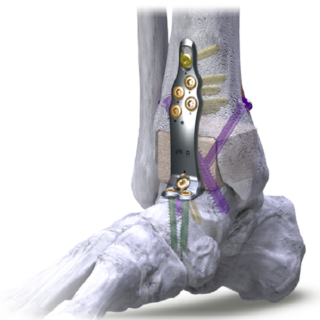
True circular-arc curvature follows the natural hindfoot arc for more anatomic TTC fusion.¹,²
Eliminates plantar incision, reducing soft-tissue disruption and protecting the plantar neurovascular bundle.
2× increase in calcaneal bone contact vs. straight nails for stronger distal fixation.
Improved torsional stability via threaded tibial, calcaneal, and subtalar peg fixation.
Allows varus/valgus adjustment during setup using the templating system.
Revision-friendly trajectory that avoids straight-nail tunnels and compromised bone.
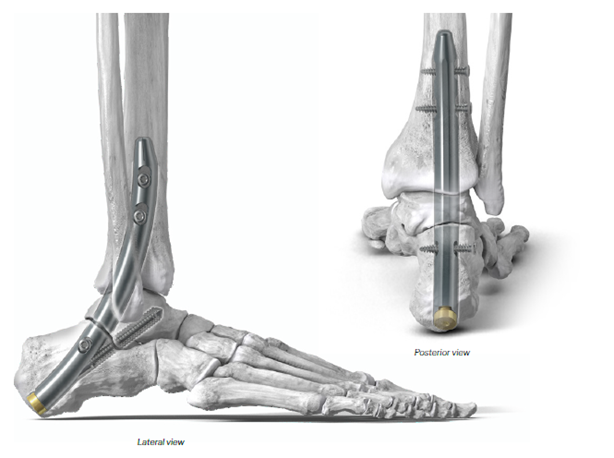
Phantom® Curved Hindfoot Fusion Nail
Diameters: 12.5 mm and 14.0 mm
Lengths: 120 mm, 140 mm, 160 mm, 180 mm
True circular-arc curvature follows the natural hindfoot arc for more anatomic TTC fusion.¹,²
Eliminates plantar incision, reducing soft-tissue disruption and protecting the plantar neurovascular bundle.
2× increase in calcaneal bone contact vs. straight nails for stronger distal fixation.
Improved torsional stability via threaded tibial, calcaneal, and subtalar peg fixation.
Allows varus/valgus adjustment during setup using the templating system.
Revision-friendly trajectory that avoids straight-nail tunnels and compromised bone.
PRODUCT DESCRIPTION
The Phantom® Curved Hindfoot Fusion Nail is engineered around one simple biomechanical truth: the hindfoot is curved—straight nails are not.
By following the hindfoot’s natural circular arc, the Phantom® Curved Nail avoids the non-anatomic pathways, soft-tissue disruption, and fixation compromises that occur when straight nails are forced into curved anatomy. This design delivers improved bone contact, stronger distal fixation, and reproducible alignment while eliminating the need for a plantar incision. By matching the hindfoot’s physiologic arc, the implant supports more natural load transfer during stance, helping align forces through the tibia and calcaneus the way the body intends—something simply not achievable with straight implants.2 This anatomic curvature also results in a 2X increase in calcaneal bone contact compared to straight nails, improving purchase where stability matters most and reducing the risk of distal loosening or varus collapse over time. The system’s threaded calcaneal and subtalar pegs then lock this increased contact area into a construct that provides for torsional resistance, helping counteract rotational forces that challenge fusion during early weight bearing.
A key benefit of the Phantom® Curved Nail System is its instrumentation. The Reaming Template, Angel Wing, and Reaming Outrigger Assembly work together to create a controlled circular-arc tunnel while still allowing the surgeon to make varus or valgus adjustments during setup. This allows for reproducible placement of the nail even in complex or previously deformed hindfeet and may reduce fluoroscopy time and limit the need for repeated repositioning. When confronting revision scenarios—especially after failed straight-nail constructs—the Phantom® Curved Nail provides a new pathway that avoids prior hardware channels and compromised cortical bone, offering reliable options for straight-nail revisions without sacrificing anatomic alignment or fixation quality.

Product Resources

LINKS
SOCIAL
CALL US
The name “Paragon 28” was chosen by design — to never lose focus on our goal to advance the science of foot and ankle surgery.
© 2026 Paragon 28, Inc.